Provincial announcement questioned by former education minister
Woodstock will soon have a francophone school.
In an announcement on Wednesday, Dec. 3, Education and Early Childhood Development Minister Claire Johnson announced $242.7 million in education infrastructure.
The money includes $9.7 million for new major projects, $4 million for large-scale capital improvements, and $229 million for ongoing projects.
One of six projects scheduled for the 2026-27 school year is a new French-language school for the Woodstock area. Other projects include three new English-language kindergarten-to-Grade 8 schools in the Oromocto area, a new K–8 school in Moncton, and mid-life upgrades for schools in Dieppe, Five Rivers, and Fredericton.
In a news release, the department said the school was “added based on census data to ensure minority language education rights are protected and promoted, as required under Section 23 of the Charter of Rights and Freedoms.”
The minister said funding a francophone school in Carleton County is a priority.
“It’s fundamental to New Brunswick that students from both linguistic communities can access the education they need in the official language they speak,” said Johnson. “We will continue to provide that, and to perform ongoing evaluations to ensure that these charter needs are met everywhere in the province.”
Federal funding for French-language education is available through Heritage Canada under the Intergovernmental Cooperation on Minority Language Education agreement. The province didn’t announce Woodstock’s specific cost, the funding it will seek from the federal government, or the school’s location in its announcement.
Woodstock-Hartland MLA and former Education Minister Bill Hogan questions the need for a francophone school in this region.
“I’m not sure that we have a sufficient francophone population to support a new school,” he said. “I’d love to know the stats.”
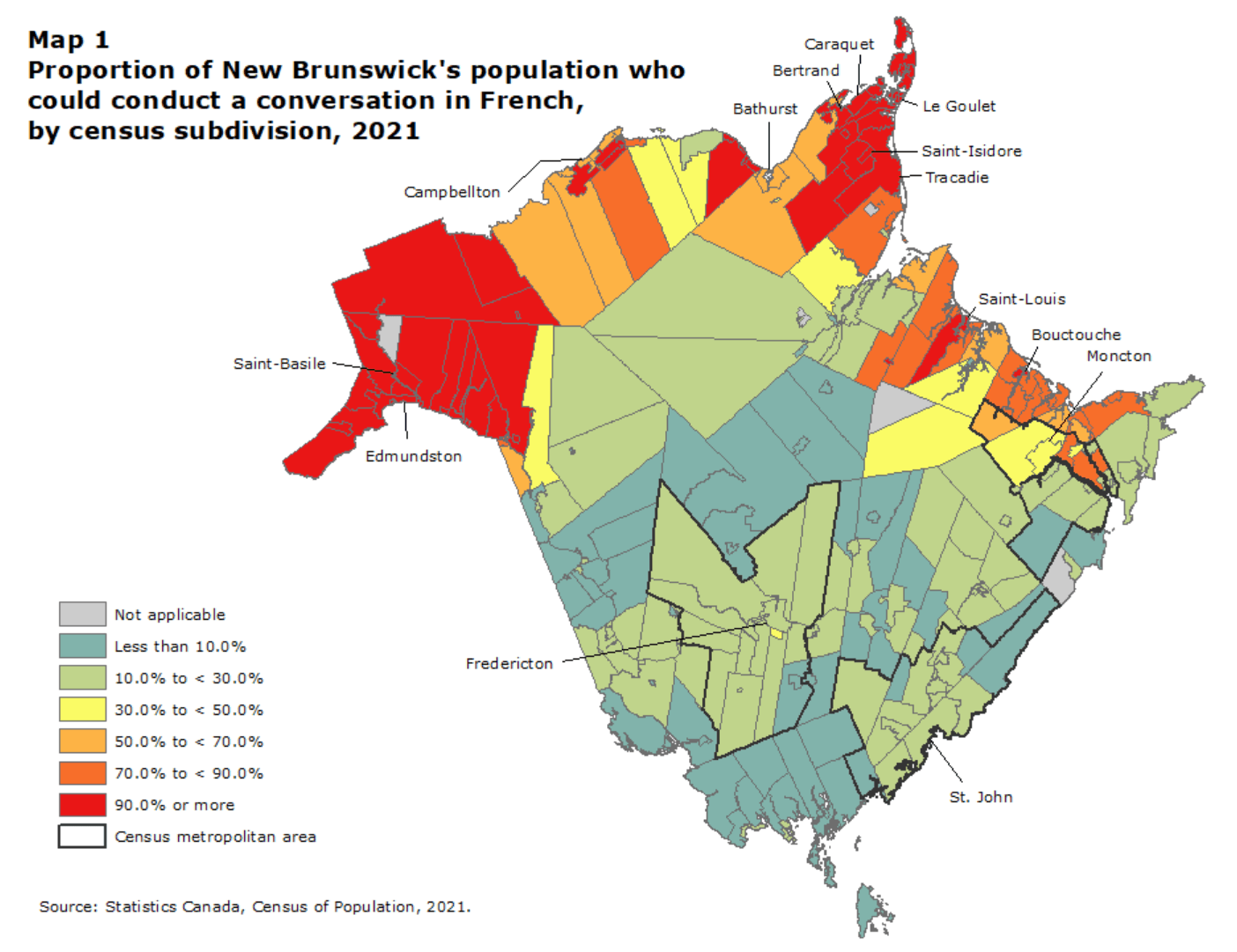
According to the 2021 Canada Census, the proportion of the population who can conduct a conversation in French in the Woodstock region was between 10 and 30 per cent. In the 2016 Canada Census, the area was listed as having fewer than 5 per cent of residents who could speak French.
In addition to individual school projects, funds announced will also pay for modular programs, new equipment, improvements and repairs, and the dust collector program to ensure schools are safe and dependable for staff and students.
On the provincial education infrastructure priority list, a mid-life upgrade for Woodstock High School is now ranked 10 out of 15.
The projects on that list are identified through the department’s annual capital planning and evaluation process. The list allows district education councils to determine which improvement projects will be required for their schools in the next five years.
Unless there is a significant change in scope or an emergency, each project on the list will remain on the list until it is funded.
More to come…