
Council given an update on proposed Battery Hill project near the town
During the Woodstock Town Council’s Special Meeting on Tuesday, Oct. 20, the mayor and councillors heard presentations from the Department of Natural Resources (DNR) officials and a mining company representative.
Manganese X Energy is hoping to develop the manganese deposit at Battery Hill, near Woodstock.
Council heard from Jennifer Welles, DNR’s Director of the Resource and Development Branch, and Neil Jacobson, Assistant Deputy Minister of the Lands and Mines Division. They also heard from professional engineer and Manganese X Energy Corporation director Desmond Tranquilla.
Manganese X Energy wants to develop a manganese deposit at Battery Hill, near Woodstock.
During DNR’s presentation, Welles and Jacobson explained the process for before, during, and after mine development, starting with the province’s geoscience team, which gathers information across the province through geological surveys.
“The federal government identified 34 critical minerals for national sovereignty of our ability to produce metals that Canada wants as well as the world wants,” said Jacobson. “Out of those 34 critical minerals, New Brunswick has 21, manganese being one. Of those 21 critical minerals listed by the federal government, 13 of them are known deposits, meaning mineable at some stage of the process exploration, hopefully someday moving into the operational side.”
Jacobson noted that New Brunswick’s critical-mineral wealth and strong geology add value to Canada as a whole.
“Not only do we have two deep-sea ports, (but we are also) connected to rail to right across the country and down the Eastern seaboard. We have 44,000 km of wood roads in New Brunswick,” he added. “We say then to the federal government, ‘we have a project of choice because it is designated.’ Therefore, New Brunswick wants special attention.”
Jacobson said that providing a guaranteed supply of critical minerals over several years for Canada and other G7 nations would help ensure national defence and support clean energy, batteries, indium, and other technology projects. He also noted that it would boost local benefits, including more jobs, royalties to the Province, local taxes, and economic growth.
Prospectors review those surveys to identify where they might stake a claim. To begin exploratory work, prospectors must operate with the landowner’s permission and pre-agreed compensation for any damage during exploration, have notice of planned work, and hold the appropriate work authorizations.
Exploration work could involve downing trees, building temporary roads, drilling, trenching and other activities.
“During that time a claim may change hands several times because people that are really good at initial prospecting may not specialize in the later stages,” explained Welles. “We work with whoever’s got the claim and make sure that they do a certain amount of work each year to keep the project moving.”
Once a company is confident it has something worth developing, Welles said it can begin transforming that site into a functioning mine. While the mine operates, it must follow environmental, health, and safety regulations and pay annual fees.
“Once they get that, they can start their operation, operate for however many years, and then of course do reclamation,” said Welles. “We target progressive reclamation wherever it’s possible,” she explained. “This is an area where we are really promoting dialogue with the neighbours. If there’s community nearby, let’s work with the community to see what would you like to see in this site. Sometimes it’s back to nature. Sometimes it’s a mountain bike park as we see in the Minto coal mines, or there might be some really innovative things that the community wants to see.”
DNR officials also noted that the Mineral Resources Act from 1985 is currently being refreshed. They are working on changes to keep projects moving while improving engagement with Indigenous and local communities and finding ways to enhance environmental investment.
“We were in a situation prior to the change on the regulation for the last, I’ll say 20 years, where we thought our money was good and maybe it wasn’t. So the new change to the regulation ensures that we are protecting the taxpayer, the rights of holders, municipalities, citizens of the province who are really the shareholders of the resource, to ensure that companies are actually the ones paying the bill in the future and not the taxpayers of the province.”
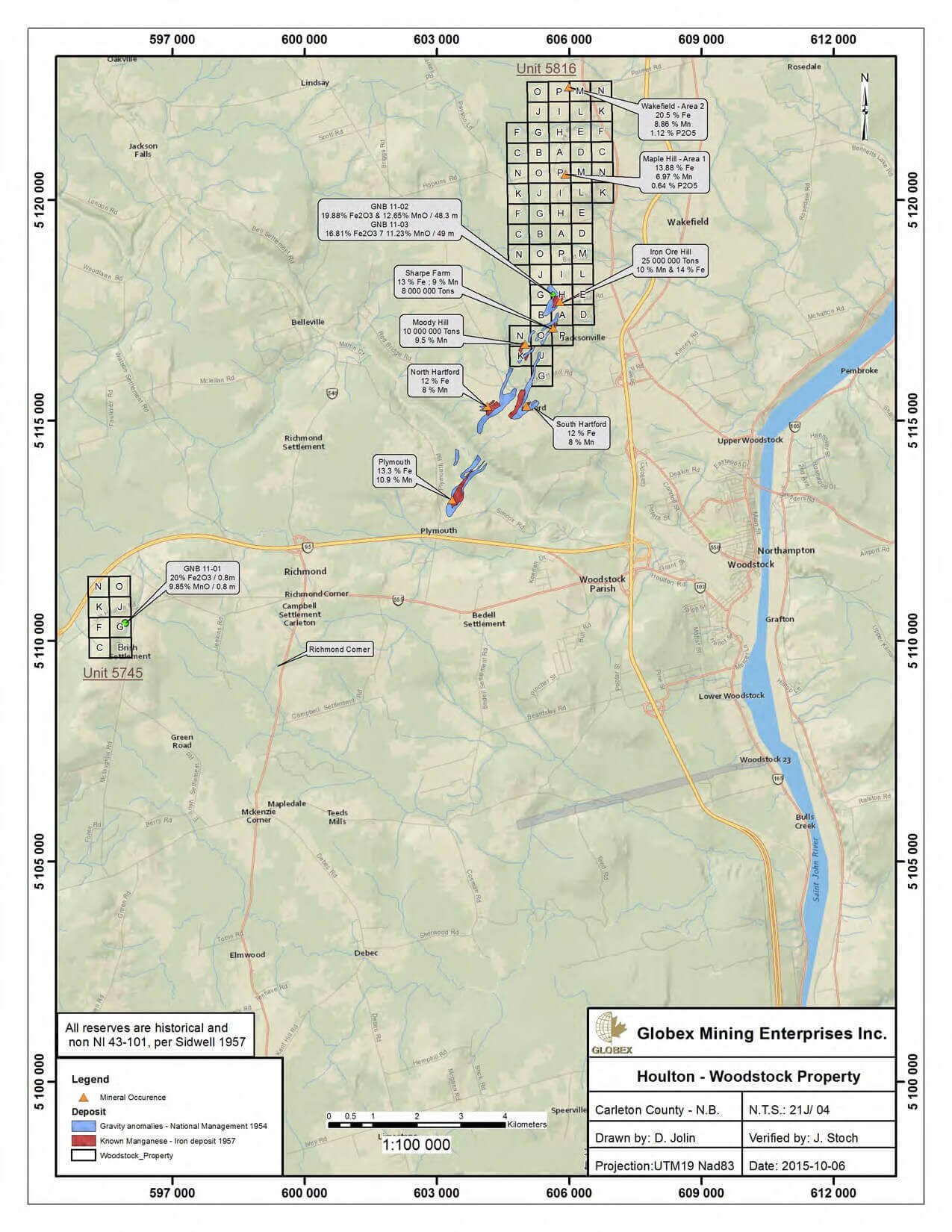
During Manganese X Energy representative Desmon Tranquilla’s presentation, he told the council that Manganese is highly prized as a cheaper alternative to cobalt in batteries and is therefore highly sought after. China currently supplies 90 per cent of high-purity manganese. Manganese X has been developing its Battery Hill project near Woodstock, with 55 claims spanning 1,228 hectares. It is one of North America’s largest manganese carbonate deposits. The zones include Iron Ore Hill, Moody Hill, Sharpe Farm, Maple Hill, and Wakefield.
In 2022, the team did an early preliminary assessment.
“They came up with a net present value of basically a half a billion dollars. So if you take a look at what the project’s worth, take a look at it today,” said Tranquilla. “An internal rate of return of 25 per cent. That’s healthy. Now remember this is based on three to five per cent engineering, so don’t get too excited.”
The estimated capital cost to build an established facility is $350 million, with annual gross revenue of $177 million, and around 75 percent fed back into the community. The process plant has a projected lifespan of 47 years.
“Do you realize how much of an impact it is on the local community? Go to Cochrane, Ontario, and see what the Detour Lake Mine did to Cochrane. Go to Fort McMurray Mine. Yes, we get synthetic crude out of it. It’s an open-pit mine. You might not like the sites, but look at the wages,” explained Tranquilla. “It’s the desire to have it here in a responsible and equitable way.”
He said the company is currently working with ABH Engineering and GEMTEC on a pre-feasibility study, which should be completed before Christmas. Tranquilla said that once it’s finished, he would like the opportunity to come back and speak with the community more.
If everything goes according to plan, their tentative timeline is to have a demonstration plant up and running, begin a feasibility study, and submit applications for environmental and mining permits in 2027. In 2028, they’d like to prepare mining construction for modular production and finalize necessary permitting. By 2029, they aim to finalize construction and commercial production.
Tranquilla stressed that none of this is official yet.
“We don’t have a project yet. We’re hoping we’re going to. We’re confident we will, but we have to substantiate it with engineering,” he said.
Woodstock Town Council plans to hold a public forum where residents can ask questions at some point in the future.