
Horizon and Vitalité officials say the new biomarker test will help track disease activity and improve access to care for people living with multiple sclerosis
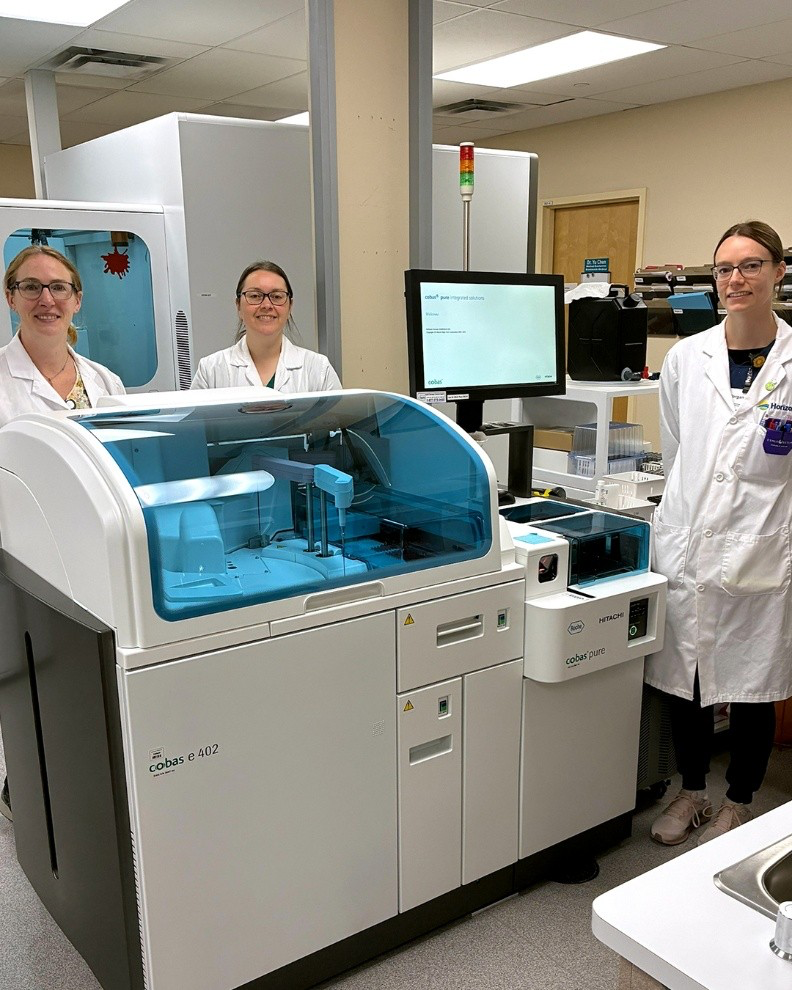
New Brunswickers with multiple sclerosis (MS) can now access neurofilament light chain (NfL) blood testing after Horizon Health Network’s Dr. Everett Chalmers Regional Hospital (DECRH) successfully validated the test.
This launch marks a breakthrough in a province-wide partnership between Horizon Health Network (Horizon), Vitalité Health Network (Vitalité) and Roche Canada to introduce NfL testing in New Brunswick.
The initiative was first announced in November 2025, with the goal of providing more timely and fair access to the blood test for people living with MS.
“At Roche, our commitment extends well beyond diagnosis – we are dedicated to providing individuals living with multiple sclerosis and their families with what they need most: personalized care and stability,” said Michele D’Elia, PhD, Executive Director, Medical, Access and Policy, Roche Diagnostics Canada.
“Through close collaboration with healthcare leaders and patients in New Brunswick, we have aligned on a shared vision to innovate across the entire care pathway. By standardizing disease activity detection and making it more accessible, our goal is to improve long-term outcomes and ensure that no shift in disease progression goes unnoticed.”
Bringing NfL testing closer to New Brunswick patients
“Neurofilament light chain is an emerging biomarker for neuroaxonal damage and disease activity. I believe the addition of this test will enhance the care of patients with multiple sclerosis in New Brunswick, a province with a higher than national average prevalence,” said Dr. Yu Chen, Medical Biochemist and Division Head (Clinical Biochemistry) at Horizon’s Dr. Everett Chalmers Regional Hospital and lead for the NfL bioassay validation.
NfL testing measures proteins in blood linked to nerve cell damage and can give clinicians more information about disease activity in people living with MS. The test can favour existing ways of monitoring the disease and help inform treatment and disease-management decisions.
NfL testing was previously only available to select New Brunswickers who met specific criteria, with samples sent outside the province for analysis. Establishing validated testing at DECRH supports a coordinated, province-wide approach to NfL testing and is expected to provide clinicians with more timely access to results – cutting existing turnaround times from several weeks down to days.
New Brunswick is the first province in Canada to carry out a coordinated, province-wide approach to NfL testing.
“Bringing neurofilament light chain testing to New Brunswick has been a multi-year effort involving collaboration across our institutions, and I am very proud to see this project finally become a reality and, most importantly, to bring another valuable tool closer to patients living with MS in our province,” said Dr. Chadi Darwich, Chief Neurologist with Vitalité Health Network and principal investigator of the Health System Impact Study.
“Having a blood-based biomarker available locally may help clinicians identify increased disease activity or a possible relapse more quickly and support earlier treatment decisions when appropriate.”
Studying the impact on MS care
With validated NfL testing now moving into clinical practice, Horizon and Vitalité are also beginning a Health System Impact Study to evaluate how the test affects MS care in New Brunswick. Horizon and Vitalité are conducting the study jointly, with support from Roche Canada and ResearchNB. Horizon’s research contribution is being led through the Atlantic Health Institute.
Researchers will examine how NfL testing is used in clinical practice and its impact on people living with MS, health care providers and the health system. The study will look at areas such as MRI use, MS treatment decisions, specialist visits and hospitalizations, as well as patient and clinician experiences with NfL testing.
“This is exactly the kind of work the Atlantic Health Institute is intended to support: bringing researchers, clinicians and health-system partners together to understand whether innovations lead to meaningful improvements for patients and the health system,” said Dr. Paul Atkinson, Chief Scientific Officer, Atlantic Health Institute, Horizon Health Network. “By studying neurofilament light chain (NfL) blood testing as it is introduced into real-world care, we have an opportunity to generate evidence that can help inform how multiple sclerosis services are delivered in New Brunswick.”
The findings will help inform future decisions about how NfL testing is integrated into MS care across the province.