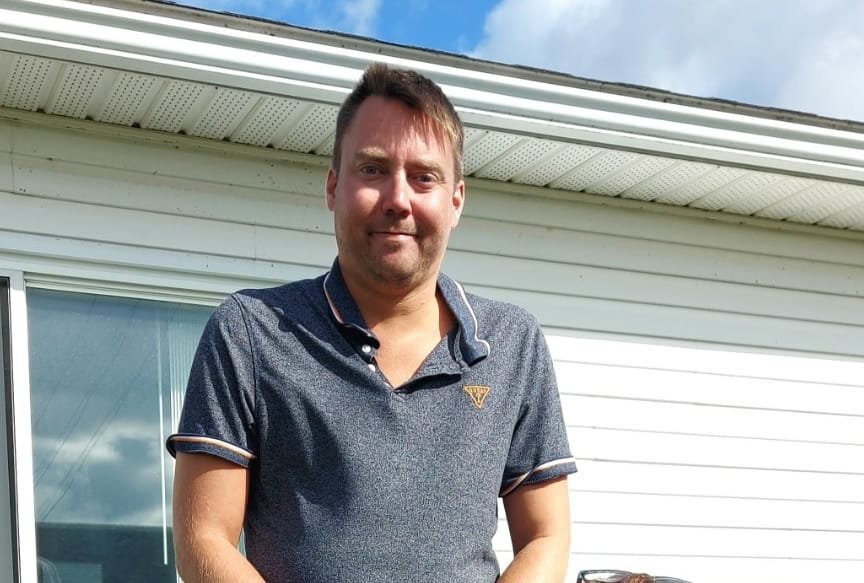
The 33-year-old and his mother are taking their search for a living donor beyond relatives
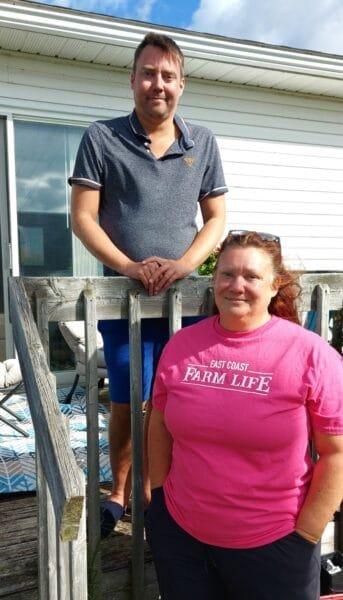
Val Mundon-McCowan of Florenceville-Bristol has watched her son endure years of medical crises. Now she is asking the public to help give him his life back.
Jesse McCowan, 33, has end-stage kidney disease. His kidney function has fallen so low that his family is searching for a healthy living donor before he has to begin dialysis.
Mundon-McCowan was visibly and understandably moved to tears as she described what her son has endured.
“Look, Jesse is my baby boy,” she said. “I’ll do whatever it takes. It’s heartbreaking that I can’t fix it.”
She added lightheartedly, “I usually do my crying in the car.”
“It’s been six or seven years. It’s been a wild ride,” Jesse said.
His kidney function, he added, has been declining “to the point of kidney failure.”
During that time, he has undergone several hernia surgeries and faced pneumonia, a stroke and anaphylactic shock. His mother said he has also dealt with severe edema, spinal tumours, biopsies and immunosuppressive treatment. She said the setbacks have been connected, directly or indirectly, to his kidney disease or the treatment it has required.
“We really still have to stay hopeful,” Mundon-McCowan said. “His kidney functions are down to 13 per cent. When they get to eight per cent, then that’s likely when they’re going to have to put him on dialysis.”
Dialysis removes waste and excess fluid from the blood when the kidneys can no longer do the job. It keeps people with kidney failure alive, but it also controls much of their routine.
“I would want to do peritoneal,” Jesse said. “If I do hit the dialysis point, I would still be able to get a transplant. It would just mean my kidney function has hit a point where they can’t leave it, and the dialysis would act as my kidneys until I can get a transplant.”
Peritoneal dialysis is done every day. Some patients must drain and replace dialysis fluid four to six times daily, with each exchange taking about 30 to 40 minutes. Others use a machine that performs several exchanges overnight.
Dialysis can also mean strict limits on food and fluids, daily care of an access site and planning work, travel and family life around treatment.
A transplant can free a patient from that routine, although it is a treatment rather than a cure. Recipients must take daily anti-rejection medication. A working transplant filters the blood better than dialysis and can substantially extend a patient’s life.
A major study published in the New England Journal of Medicine found projected gains of as much as 17 years compared with remaining on dialysis, with younger adults receiving the greatest benefit.
Jesse and his mother said every family member who could be tested has been tested. None has been able to donate, pushing the search beyond relatives and into the community.
Mundon-McCowan took the search public on Aug. 10, posting an appeal for a living donor.
“We are looking for a donor to give him back his quality of life,” she said.
Jesse is one of thousands of Canadians who need a kidney. The Canadian Institute for Health Information reported that 4,044 people were waiting for a solid organ transplant at the end of 2024. Just over 70 percent were waiting for a kidney.
New Brunswick recorded 229.4 new cases of end-stage kidney disease per million people in 2024, one of the highest rates in Canada.
A living kidney donor does not have to be related to Jesse. Canadian Blood Services says any healthy adult can be considered after a full medical assessment. In New Brunswick, donors must be at least 19. There is no strict upper age limit for a person healthy enough to donate.
Potential donors undergo testing to determine whether donating would be safe and whether their blood and tissue types match Jesse’s. Healthy donors can live full lives with one kidney.
A medically eligible donor who is not compatible with Jesse may still be able to help through the national Kidney Paired Donation program. An incompatible donor can give a kidney to another patient while Jesse receives one from a compatible donor. Some matches form longer chains involving several transplants.
Friends have helped carry the appeal beyond the family’s immediate circle.
“A lot of friends have shared the posts and urged others to come forward,” Mundon-McCowan said.
She hopes people who cannot donate will keep sharing Jesse’s story until it reaches someone who can.
Anyone interested in being assessed as a possible donor for Jesse can contact Michele McDade, RN, with Horizon Health Network’s living-donor program, at 506-648-6968 or Michele.McDade@HorizonNB.ca. You can also reach the Saint John Regional Hospital Living Donor Program at 506-648-6850.
The transplant team will decide whether a potential donor is medically eligible. Mundon-McCowan wants people to consider being assessed and to keep sharing Jesse’s appeal.
“Really, this could happen to anybody,” she said.