
Council also discusses dog control issues
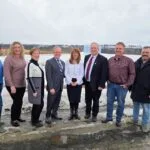
As part of a general information tour, Irving Woodlands is briefing New Brunswick municipalities about its operations. Recently, Andrew Willet, JDI’s Director of Sustainability & Indigenous Relations, and Robert Fawcett, JDI’s Director of Corporate Relations, Forestry, discussed the company’s economic and environmental impact within the District of Carleton North.
The pair shared that the New Brunswick forest products sector supports approximately 26,000 jobs, $2.7 billion in local spending, and approximately $980 million in taxes and royalties. In Carleton North, the company supports employment and property tax contributions, forest management and balanced sustainability, watercourse protection, biodiversity monitoring, and forest regeneration, with 34 million trees planted in 2026 in New Brunswick, Nova Scotia, and Maine.
Willet noted that many people believe all Irving does is “cut and truck wood.” However, he said that “a lot of the activities we are doing are on the other end of that,” and explained that they also operate a seed orchard and multiple tree nurseries. They are also involved in tree planting, forest protection, recreation planning, and conservation efforts including bird and wildlife monitoring.
In the ensuing conversation with the council members, led primarily by Councillor Ryan Dickinson, Willet and Fawcett shared that Irving primarily plants white spruce, with some Norway spruce, red spruce, and pine. They acknowledged that the company is often criticized for converting hardwood into softwood. However, Willet shared that they have not been allowed to convert forest for twenty years, and they do not want to.
“Nothing could be further from the truth,” said Fawcett, noting that Irving’s growing business sector is the tissue industry. He explained that tissue products are made from an equal mix of both hard and softwood, making hardwood very important to them.
“We don’t want to convert hardwood to softwood, and we don’t want to lose any of the hardwood forests that we have,” he told council.
Fawcett also acknowledged that the company is often asked why they do not plant hardwood trees. He explained that they plant only softwood because hardwood trees regenerate on their own.
“You don’t need to. It grows back all by itself.”
Willet also explained, “Hardwood seeds itself really well, so if you leave a few seed trees,” said Willet, “you’ll get a really good crop in a few years.”
The pair noted that the company needs strong public support.
“The government isn’t going to provide us with a strong wood supply if there isn’t strong public support and companies aren’t going to invest capital if a business isn’t wanted.”
They advised that representatives are always “happy to come and talk, take people on tours, answer any questions, and be transparent.”
NBSPCA dog control quarterly update
CAO Amy McIntosh shared an overview of the NBSPCA’s quarterly dog control report with council members. From July 1 to Sept. 30, the SPCA conducted 18 patrols and handled 15 investigations in the municipality.
Of those, six involved dog bite incidents, one of which involved a dog killing another animal, and one involved a person who required hospital treatment.
Given the frequency of biting incidents, council agreed to review and consider amending the current Dog Control By-law.