With a herd attuned to human physiology, the founders of Ara Equus say their therapy helps clients find clarity, calm, and a truer sense of self
After about five years in the industry in rural Ontario, Tina Pennacchio and Susan Marie have brought Ara Equus to Carleton County.
The two co-founders are based in Bedell, near Woodstock. They moved to the area to provide the region with the psychological assistance Susan Marie needed and couldn’t get when she lived in the Maritimes.
“We came back to the Maritimes to give back. The services are still not here that I needed in my early 30s to save my life. Coming to a region where there is a shortage of mental health practitioners, this is one of the reasons why we chose this particular region, because we could bring that, and help find what I didn’t have,” said Marie.
According to the College of Licensed Counselling Therapists of New Brunswick, there are approximately 400 to 600 Licensed Counselling Therapists, including candidates, in New Brunswick. This group comprises of clinical therapists, psychotherapists, and marriage/family therapists and only 50 are trauma-focused. There are only 50 to 60 psychiatrists in the entire province. Social workers fall into another category.
The two hope to give back to the region by supporting those who seek their assistance. Pennacchio says it’s all about helping people embrace themselves and feel hopeful.
“Finding their voice is a way that’s not rooted in anger, or fear, or resentment, or anything that’s unresolved, but in a place where they can really shine for who they were meant to be, who they feel they actually are,” said Pennacchio.
Pennacchio is a psychotherapist and certified trauma therapist who was drawn to this work by a horse named George. He had such an impact on her life that she felt compelled to return to university to earn her Master’s in Counselling Psychology and become a licensed psychotherapist, with a special focus on trauma and neuroscience.
The two started as Equine-Assisted Learning (EAL) facilitators but soon realized something was missing.
“Tina and I talked about it, and she decided she would go back to school and do her degree in counselling psychology and become a psychotherapist and merge that with the EAL training and the trauma training so that we could do this work in a different way than EAL. More scientifically, but also more therapeutically,” said Susan Marie.
Susan Marie, who was awarded the Queen’s Jubilee medal for her advocacy work with child sexual abuse survivors, feels this is very personal because of her past experience with the lack of support in the Maritimes.
The two are very passionate about giving back to the region by supporting those who seek their assistance. Pennacchio says it’s all about helping people embrace themselves and to feel hope again.
Together they created Ara Equus, a clinical therapy grounded in psychodynamic theory, somatic therapy, polyvagal therapy, Internal Family Systems (IFS), humanistic approaches, and the neurobiology of trauma. It is also covered under many private or employee insurance plans.
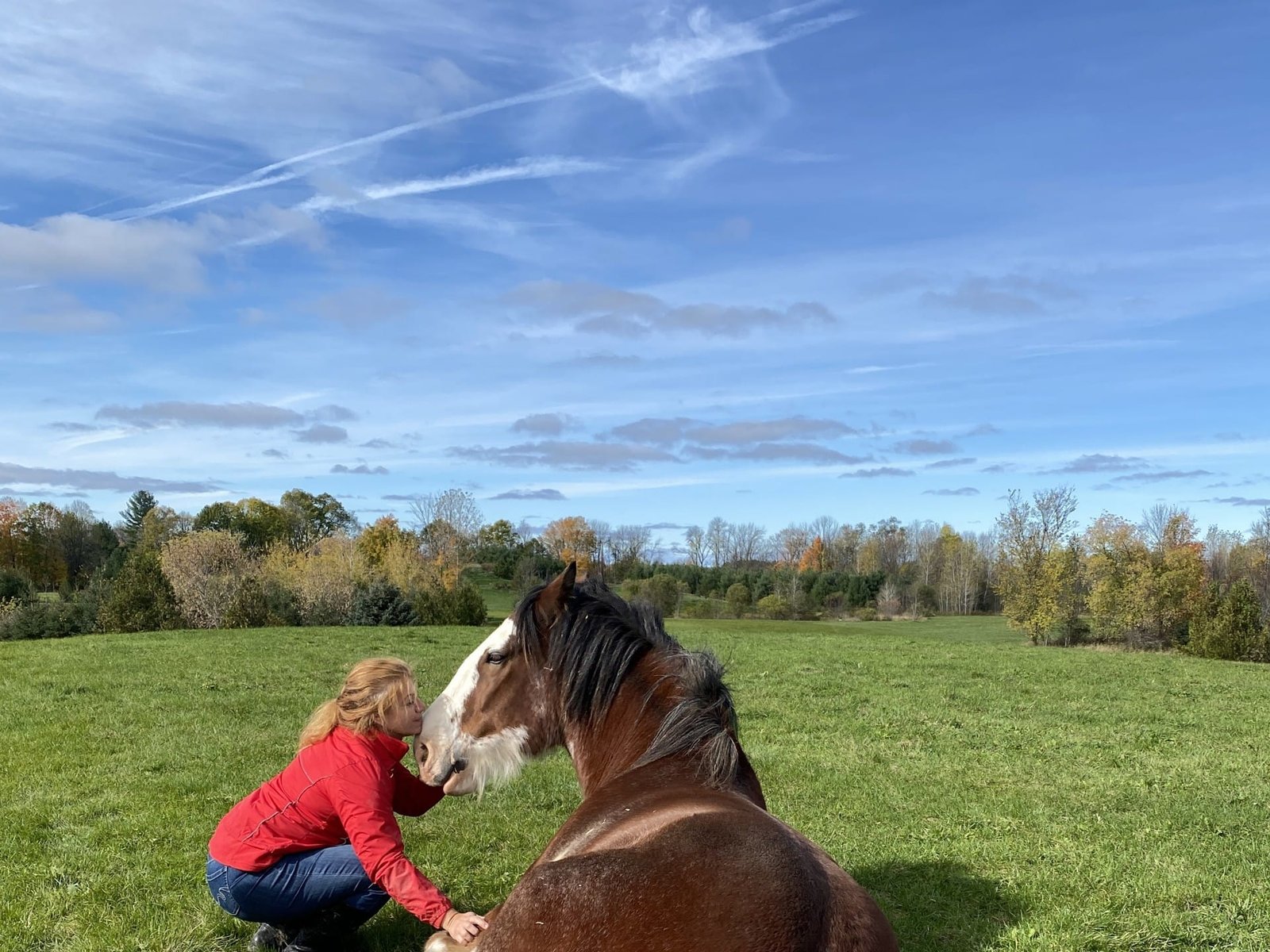
They focus on communication and consent with their horses. When their clients come, they make sure their five horses, Gus, Thunder, Raffy, Chunck, and Lilith, and their donkey, Joey, to decide for themselves how and when they connect with their clients.
“They feel the energy. The prey instinct means that they can read humans, and they read what you’re bringing in. Even if you fake it and you try to be nice, that’s not going to work for them. They want you to feel what you’re feeling, and then they’re more likely to connect with you,” said Susan Marie.
Penacchio says horses and donkeys can notice things in people that we humans are blind to.
“The horses are noticing it in your physiology. They’re responding to you in terms of your heartbeat and your breath. They’re reading your body language in a way that’s far more attuned than what humans generally do,” said Pennacchio.
“Being a practitioner, I look for those things, and I have learned to identify them just in regular life, but oftentimes I miss them because I’m not a horse.”
The two believe equine-supported therapy can be a gateway to unlocking the best version of yourself and a gateway to releasing what has been stuck for a very long time. Some people come to the farm not because they need ‘therapy’ but because they leave feeling more inspired, more grounded and more empowered.
For more information, go to araequus.com.