Supporters believe decision short-sighted
Members of New Brunswick’s agricultural and livestock sector are still reeling from the New Brunswick Government’s announcement on March 17 that they will phase out provincial veterinary, equine and lab services for livestock and large animals over the next two years.
Public veterinary services will end March 31, 2027; equine services will end Dec. 31, 2026, and laboratory services will end March 31, 2028. Those measures were announced as part of cost-cutting efforts to help the province dig out of its massive $1.3 billion deficit.
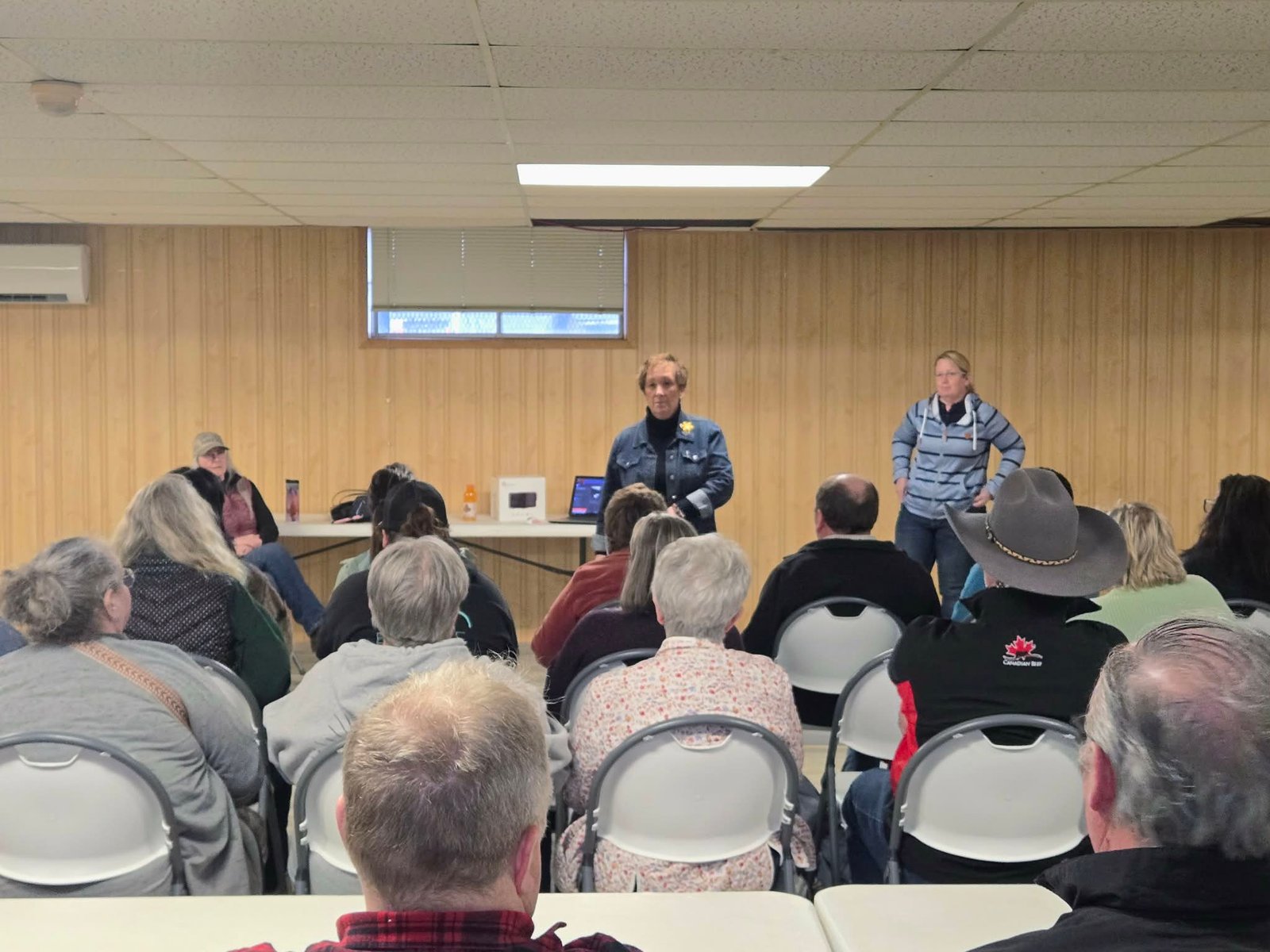
In an effort to share information and hold a “productive conversation about [possible] solutions,” the Western Valley Equestrian Association hosted a public meeting on Sunday, April 19. The gathering, which drew approximately 30 people, was open to all equestrians, farmers, and livestock owners.
Also in attendance were a number of provincial veterinarians, Carleton-Victoria MLA and former Minister of Agriculture Margaret Johnson, former premier David Alward, and the president of the Agricultural Alliance of New Brunswick, Danielle Connell.
Kim Tompkins, President of the Western Valley Equestrian Association, opened the meeting by acknowledging that there are “a lot of strong concerns and emotions,” but that the purpose of the meeting was not to vent, but to “come up with actions.”
MLA Margaret Johnson, a strong advocate for the agricultural community, spoke at the meeting, addressing the challenges privatizing services will create for the province.
Of particular concern is the fact that New Brunswick is already facing a shortage of large-animal vets, as most veterinary graduates prefer to enter small-animal practices.
“These [large animal] vets are going out in the middle of the night, they’re dealing with 2,000 pounds that have a mind of their own, and the stalls are not necessarily pristine,” said Johnson, as she also acknowledged the physical risks that large-animal vets take on.
“We’re insecure and short-handed,” said Johnson, noting there are currently only three large-animal vets to cover Edmundston to Nackawic.
Johnson acknowledged a shared fear that privatizing veterinary services in the province will deter those interested in becoming large-animal vets.
“Many vets don’t come out of university with a business acumen; they have no interest in running a private practice,” said Johnson. She noted that veterinary school graduates are “already up to their eyeballs in debt” and that asking them to take on the expense of starting their own private practice will be too much for many.
Danielle Clark, President of the Agricultural Alliance of New Brunswick (AANB), told those who were gathered at the meeting that the AANB has asked the province for a “one-year pause” on its decision to allow time for a proper evaluation of the impact privatization will have on the agricultural sector and New Brunswick residents as a whole.
“We’re not asking them to cancel it,” said Clark, “just pause.”
Clark noted that the province has stated that public veterinary services cost the government $4 million per year, which the farming community has offered to cover.
“Several proposals have been made to the Department of Agriculture to increase the fees, but for whatever reason, they have not been increased. So now, there is a $4,000,000 deficit they are using as a reason to get out of business,” she said.
Clark shared that at the first meeting with the Minister of Agriculture, the Alliance immediately offered to cover the deficit, to no avail, leaving the Alliance and the agricultural sector to ponder the reasons behind the decision.
“If it’s not the money, then what is it,” Clark asked, alleging that they were informed during the meeting that the problem now lies with “the small farms and horses.”
She said they are now making it their mission to “prove the value of the small farms and horses; we don’t feel they have any argument after that.”
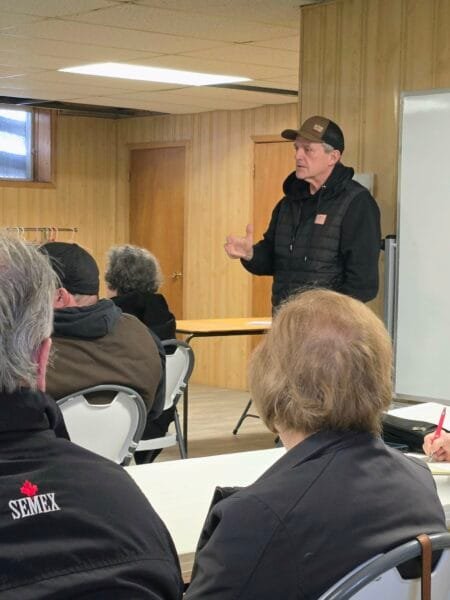
David Alward, former premier and former agriculture minister, said there is a “misperception from the Department of Agriculture” that the equine industry is merely recreational and doesn’t add value.
“We need a shift within the department to understand that it adds value…to our province,” he told people in attendance.
Alward, as well as Clark and others, noted that the equine community generates income and stimulates local economies through lessons, events, feed purchasing, and equipment stores, and, even more importantly, by keeping farmland actively cleared.
According to information shared by the AANB on their website, “With an estimated 14,000 horses in the province, the equine sector drives demand for over 2.55 million bales of hay annually — worth more than $20 million — and keeps 30,000+ acres of farmland actively cleared and productive.”
The organization also noted that the equine community “cuts or purchases hay from many fields registered in the FLIP program,” which keeps acreage cleared and ready for future food production or livestock pasture.
Johnson said that since COVID, there has been a noticeable increase in the number of New Brunswick residents purchasing meat from small, local farmers.
“They want to know where their food is coming from,” said Johnson, acknowledging that small farmers will be especially vulnerable to the impacts of privatization.
The consensus of those in attendance was that privatizing will result in a serious shortage of available veterinary services, a reduced level of care for the agricultural sector, which will negatively impact herds, small and large alike, and that costs will increase significantly for farmers, which will have a negative impact on all New Brunswick residents.
Clark said they are actively seeking veterinarians to join the alliance so they can have as broad and united a representation as possible when approaching the government.
Margaret Johnson told the crowd that there was one positive outcome of the province’s March announcement.
“If anything, we can be thrilled that New Brunswick is paying attention to agriculture more today than ever. That’s wonderful – people who aren’t even engaged in the sector are paying attention and realizing this is going to have an impact on all of us.”