
New Brunswick Department of Health clarifies rules and regulations regarding practice
Some New Brunswickers whose doctors have retired were shocked to discover there is a fee to have their medical records sent to them.
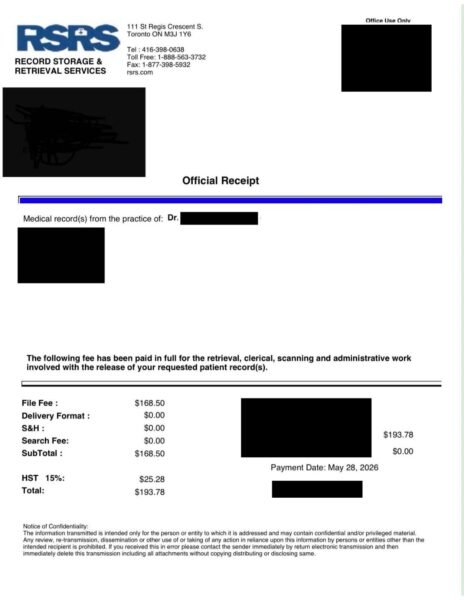
Orphaned patients describe receiving communications from RSRS Records Solutions stating that the company now possesses their medical records.
Once contacted, ex-patients then describe being charged various sums to receive the records, with many paying as much as $200.
“Of course I paid it; what choice do I have,” said a Carleton County woman currently undergoing diagnostic testing who did not want to be named.
“Right now, I am going to be without a doctor in the middle of diagnostic tests to determine if I have breast cancer. So, for a family of four, it’s almost $1,000. How many can afford this?”
RSRS, an Ontario-based company founded in 1997, specializes in medical practice closures and transitions.
“The patient has a right to full access and the surety that their personal information remains confidential. We provide proper notification to active patients, and we also have a patient services centre with agents to assist with information… Our patient transfer fees are non-prohibitive. Most importantly, we never make the fee for medical record copies a barrier to receiving the file,” says RSRS on their website in response to the question “what services will you provide to … [ex-]patients.”
“We have a process whereby we try to understand the situation that the patient is experiencing. We work with them to ensure that they can access their file “ said Elan Eisen, Director of Services at RSRS, when asked what options there are for an ex-patient who cannot afford the cost of the records.
“RSRS was put into place almost 30 years ago to fill a very important gap in the healthcare system … due to a lack of interoperability in [it] ” said Eisen when asked what the public should know about RSRS.
He went on to say that family doctor records are often disconnected from central databases, and that RSRS fills that critical gap, ensuring records are not lost when a family doctor retires.
A spokesperson for the province said doctors use a number of approaches when retiring or closing their medical practices.
“Once physicians cease practising, they may use different methods to transfer and/or retain medical records, via direct transfer or subcontracting third-party companies,” said Morgan Bell, Communications Officer for the Department of Health.
“Records containing personal health information are subject to the Personal Health Information Privacy and Access Act (PHIPAA) and its regulations, which establish rules for their collection, use, disclosure, retention, and protection, while safeguarding confidentiality and supporting individuals’ rights of access, ” Bell continued.
The process of a retiring physician transferring documents to a private company is common, according to Dr. Leisha Hawker, former President of Doctors Nova Scotia.
“Most physicians choose to contract with a secure company that can meet the legislative privacy and security requirements,” said Hawker in an interview with CBC.