Charges stemmed from chaotic arrest in Richmond Corner, where an Indigenous woman suffered serious injuries
acquitted
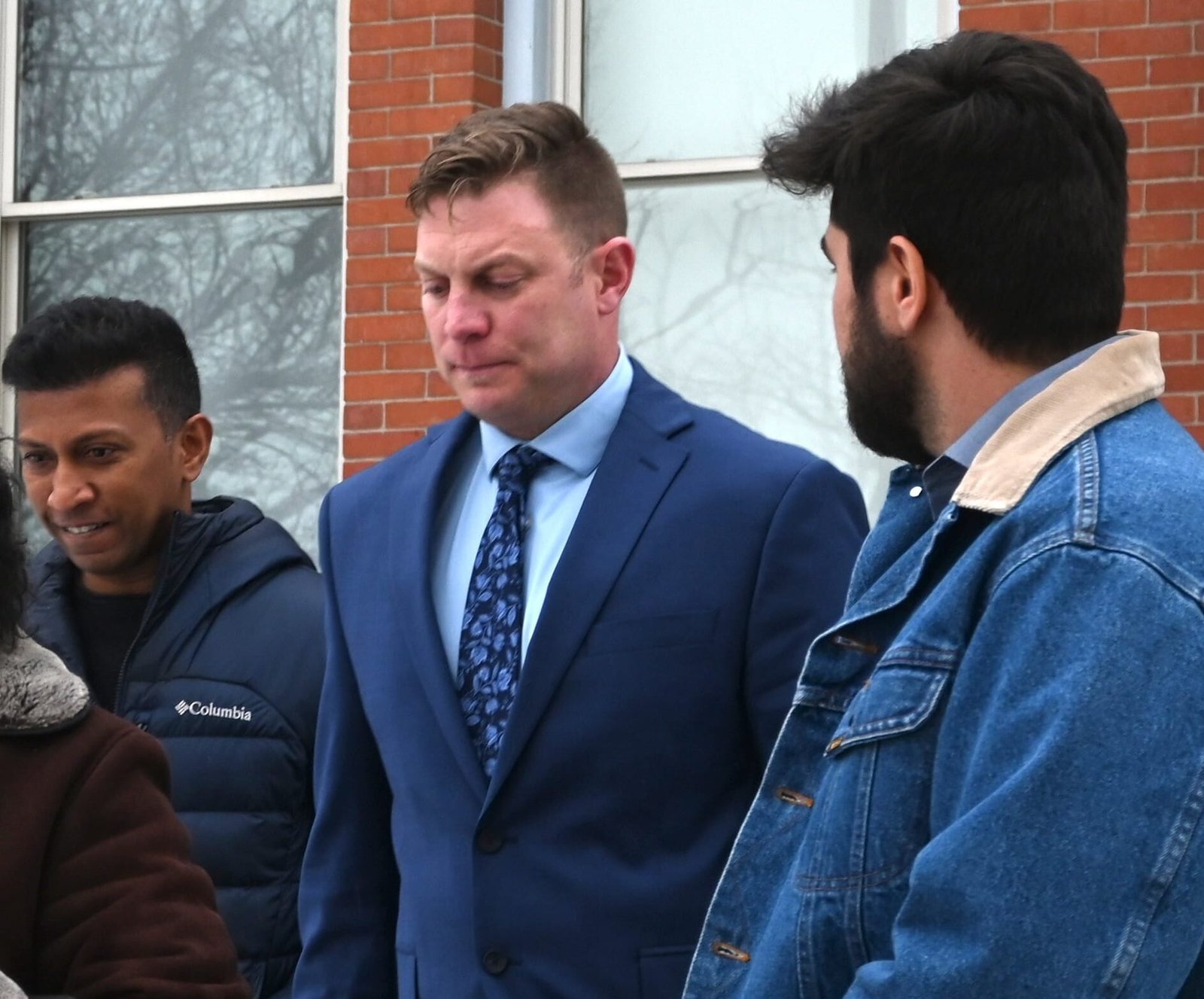
Court of King’s Bench Justice Christa Bourque took close to 90 minutes to read her decision to a packed courtroom in Woodstock on Friday, May 1.
“The court is not satisfied that the Crown has proven the offence of aggravated assault or included offence of assault causing bodily harm, beyond a reasonable doubt,” she said. “Andrew Whiteway is, therefore, found not guilty.”
The injured woman, Christina Gillis, is Mi’kmaq and originally from the Eskasoni First Nation in Nova Scotia. She was not in the courtroom for the verdict, but some of her family members attended, including her common-law husband, Woodstock Police Force (WPF) Cst. Barry “Scotty” Scott.
After the verdict was delivered, Cst. Scott got up to leave, but stopped to shake Cpl. Whitway’s hand on the way out, leaning in to say something to the officer, each of them patting the other on the back before Scott left.
Cpl. Whiteway was charged with aggravated assault in Sept. 2024 after an investigation into a domestic disturbance in June 2024 that ended with Gillis being injured after resisting arrest. The charges were filed by the Serious Incident Response Team (SiRT).
In handing down her decision, Justice Bourque conducted a detailed assessment of each witness’s testimony, noting issues with the credibility and reliability of Gillis’, her daughter’s, and Cst. Scott’s testimony. Bourque pointed to inconsistencies between what was said on the witness stand and in written statements.
The trial, which lasted four days in January, pieced together a difficult day for Gillis and her family. Her daughter had run off after assaulting family members on a day she had been drinking and had taken multiple doses of her prescription medication.
The arrest was chaotic, with multiple officers involved, Gillis’ daughter being arrested, and WPF Cst. Scott pleading with his wife to stop resisting arrest. Whiteway and Gillis both tripped on uneven terrain, with Gillis hitting the ground face-first.
Cpl. Whitway admitted to kneeing Gillis in the back and hitting her in the face twice as the two tussled on the ground, while the officer attempted to handcuff her. In the end, it took three officers to subdue Gillis, as her husband pleaded for her to stop resisting arrest.
Defence counsel T.J. Burke said today was a win for his client, but also a win for the law.
“The charge was very serious; that’s guaranteed federal jail time. Police officers generally don’t do well in federal jails.”
Burke said the court was diligent in weighing the evidence.
“The real winner today is the justice system,” he added, “because it vets out these types of complaints that are meritless and have no foundation in the law.”
In taking on the case, Burke faced criticism for defending a white police officer on charges involving an Indigenous woman.
“I’m proud of my culture, and I’m proud of my heritage, and I’m proud of my upbringing as well,” said Burke, noting his grandfather was an Indigenous leader who helped start the Union of New Brunswick Indians, the first lobby group for First Nations in the province. He said his grandfather taught him and his aunts and uncles the importance of social justice; lessons he still uses today.
“I don’t care whether you’re black, or white, or Asian, or Indigenous. I took on AJ’s file because after I read it, I believed in him,” he said. “You know, justice is supposed to be blind, and just because I’m Indigenous doesn’t mean I’m not going to represent an individual who is callously shamed and arrested on bogus allegations. What do you do in a circumstance where somebody comes to you, and they’re looking at real jail time and losing their career? Do you just say, ‘Look, I’m not going to represent you because I’m Indigenous, and this is an Indigenous woman,’ or do you step up and act appropriately? That’s why I took the case.”