Officials won’t release safety reports/investigation findings after death of three year old
It’s been three months since Gunnar Dickison was killed at the Connell Park Raceway in Woodstock. Yet, very little information has been released about the circumstances surrounding the toddler’s death.
Gunnar, who would have turned four on June 27, died after being struck by the starting gate on the opening day of the harness racing season on June 14.
A safety review conducted by the Town of Woodstock has not been released, the provincial coroner has not made his report public, Horse Racing New Brunswick won’t release their findings, and the Woodstock Police Force is not making any of its investigation public until the Crown prosecutor’s office has a chance to review its findings.
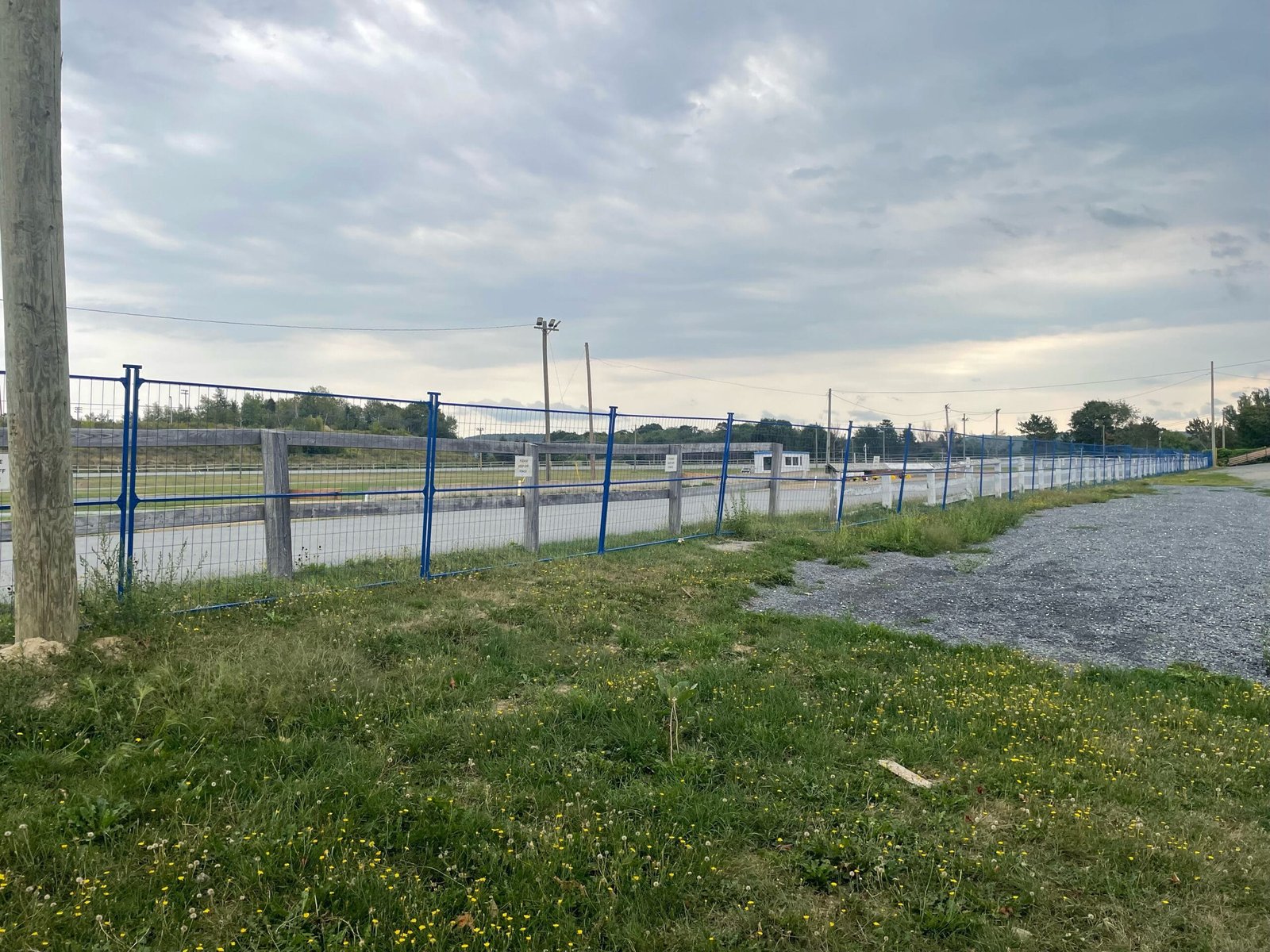
Shortly after the accident, the town suspended all activity at the track and announced it would conduct a comprehensive safety review with each of the facility’s users. Plans are underway to install safety fencing along the racetrack.

The River Valley Sun reviewed harness racing rules for tracks in New Brunswick, Prince Edward Island, and Nova Scotia.
Across hundreds of pages of documents, there is no mention of, or rules regarding, spectator safety.
The regulations governing the Atlantic Provinces Harness Racing Commission (APHRC) were updated earlier this year and do not mention safety protocols for people attending the races.
CLICK HERE TO REVIEW THE APHRC RULE BOOK
Finding out who is responsible for spectators’ safety has proved difficult.
The track is owned by the Town of Woodstock, but is leased by the Woodstock Driving Club. The club is governed by Horse Racing New Brunswick, which is regulated by the APHRC.
The APHRC is governed by Standardbred Canada, whose mandate is to supervise, record, store and distribute information on all registered Standardbreds, and promote harness racing in Canada.

The River Valley Sun reached out to each of these organizations, requesting an interview about spectator safety. None of our calls were returned.
The Maritime Provinces Harness Racing Commission Act, adopted by all three Maritime provincial governments, established a harness racing authority with “jurisdiction to govern, regulate, and ensure the integrity of harness racing in the Maritimes.” The act is also bereft of any rules related to spectator safety.
The River Valley Sun contacted the provincial Department of Public Safety to ask what role it played in keeping spectators safe at harness races.
“The Department of Justice and Public Safety regrets this tragic loss of life,” wrote government communications officer Geoffrey Downey in an email. “The department, however, is not responsible for public safety at harness racing events. Questions about safety should be directed to the event organizers and the property owner.”
Dr. Mitchell Downey is Horse Racing New Brunswick’s president. On the day of the tragedy, he told the River Valley Sun that such an incident is “rare.”
After further research, the River Valley Sun discovered that being struck by a starting gate isn’t as rare as people may think.
In 2010, five harness racing fans at the Windsor Fair in Maine were injured by the starting gate. A lawsuit against the track was finally settled in 2022.
In 2016, a photographer was injured when the starting gate slammed into the fence in Saratoga, New York.
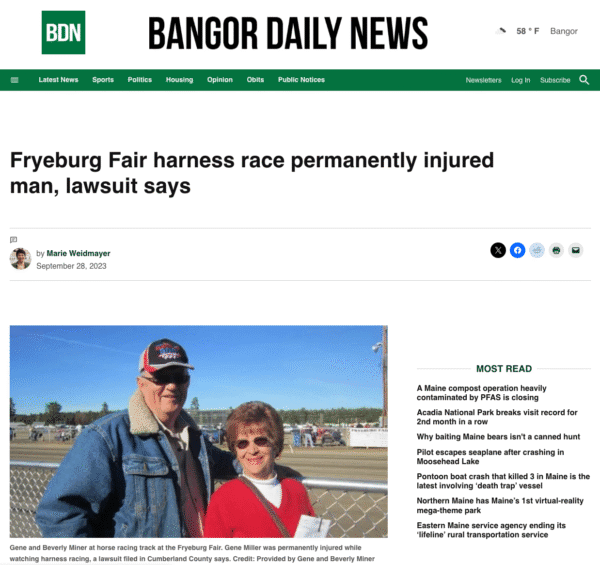
In 2022, at Maine’s Fryeburg Fair, a man was permanently injured when the starting gate struck him.
In 2023, a five-year-old from southern Illinois died after the starting gate struck her.
In all four instances, those who were injured or died were standing beside or leaning over the trackside fence when the accidents happened.
A chest-high wooden fence along the harness racing tracks has been an industry norm for decades.
Bill McFarland was the Director of Racing in 2010, when five people were injured by the starting gate at the Windsor Fair.
“They were rail birds,” he said, referring to the people who were injured. ‘Rail birds’ is industry slang to describe people who stand at and lean over the fence directly adjacent to the harness racing track.
“They were leaning over the fence and went down like dominoes. One wasn’t all that injured, the last guy, but the first guy was seriously injured. The others three that were hurt settled out of court, but the other guy sued, and his case was finally settled in 2022,” he told the River Valley Sun.
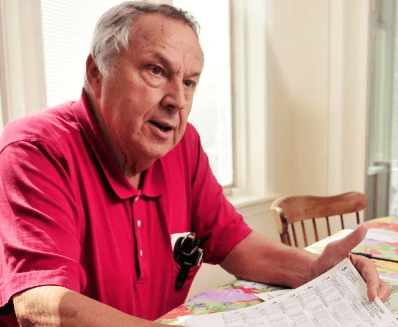
When asked what safety measures were taken at the track after the accident, McFarland was quick to answer.
“None,” he said. “We didn’t change a thing. People learned their lesson and we haven’t had an issue since. We knew this was a freak accident. People know what will happen if they lean over too much, so they don’t.”
When the River Valley Sun asked McFarland if track owners would have made changes had someone died, he was blunt.
“Oh, probably,” he said. “But no one died, so there wasn’t a need.”
A long-time member of a provincial harness racing organization in Atlantic Canada, who did not want to be named for fear of repercussions, said the accident that killed Dickison is a wake-up call for the industry.
“This is uncharted territory,” he told the River Valley Sun. “No one ever expected this. No one ever thought something like this could happen.”
He said he hopes the investigations and safety reviews result in changes that ensure no one else dies.
“There are so many entities that are involved in the governing of this sport. We all have to be on the same page.”