The covered bridge community looks ahead without letting go of what makes it home
Hartland goes into this year’s municipal election with something many small towns never get and usually spend years trying to build – people already know the name.
They know it because of “The Bridge,” and like the “Old Barn,” when you say it in Hartland, everyone knows of what you’re speaking.
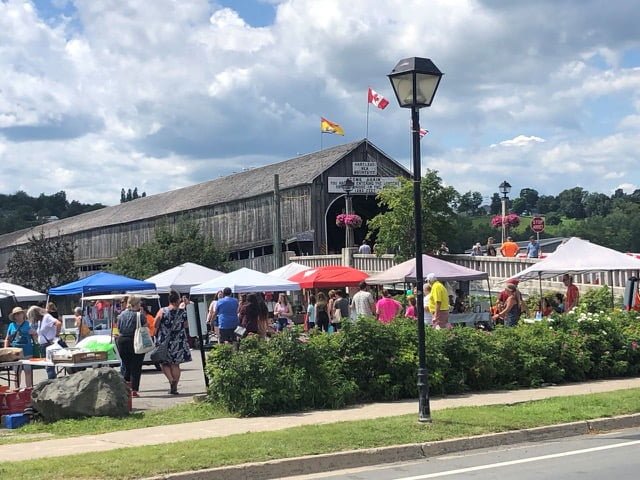
The Hartland Covered Bridge has carried the town’s public image for generations, giving it a recognizable identity that extends well beyond Carleton County. It is the landmark, the postcard view, the thing visitors stop to photograph. It is 1,282 feet long, is 125 years old this year, and remains the world’s longest covered bridge.
That kind of recognition helps, but it does not answer the harder questions a town has to answer for itself. Hartland heads into this election with many of the same pressures weighing on small communities across New Brunswick: roads and infrastructure, services, taxes, policing, housing, and the more difficult question underneath all of it, which is how to keep moving forward without peeling away the parts of the place people still care about.
A bigger Hartland means more issues
Hartland is running this election as its own local government, with its own mayor and council, and that matters because the map council answers to is broader than the old town core.
The ballot covers three wards. Ward 1 includes Somerville, Wakefield, Simonds and Peel. Ward 2 includes Hartland, Coldstream and Bubartown. Ward 3 includes Brighton. There are also three at-large council seats and the mayor’s chair.
The new ward structure means the council is no longer dealing with a single compact centre. It involves a wider area, with different roads, different service expectations, and different views of what is fair and what is not. In a municipality this size, people notice quickly when they feel their part of the map is getting less attention than somebody else’s.
The bridge is still the town’s biggest draw
There is no real point pretending that Hartland’s biggest asset, other than the tight-knit community itself, is anything but the bridge.
Most small towns would love to have a recognizable landmark. Hartland already has one. The harder part is finding a way to turn that attention into something that lasts longer than a few photos and a quick drive through town.
The town’s strategic planning points toward waterfront, park and green space development, tourism around the riverfront and docks, branding and signage work, and efforts to build more around the pull the bridge already has. That tells you where some of the thinking is. The bridge brings people in. The question is how to keep them in, and whether the town can do more with that than it has so far.
“One of the biggest things this council has done is go after grants, especially for projects like the waterfront and the new pedestrian crosswalk by the nursing home,” says long-term resident Lillian Warne. “It’s nice to finally see some movement. Other communities like Perth-Andover and Nackawic have invested in their waterfronts and created spaces that attract people, while we’ve talked about doing similar things for years without much happening—so this feels like a step in the right direction.”
The economy is small enough that people feel change quickly
Hartland’s economy is not large enough to hide very much, which is often the reality in a place this size.
Day & Ross remains one of the best-known names tied to the town. The Main Street company traces its founding there to 1950. Craig Manufacturing also remains part of the local business landscape, and Old Dutch is one of the largest employers in the area, while Covered Bridge Potato Chips has spread its famous spuds far beyond New Brunswick’s borders.
“The biggest thing that feels like it’s missing is local shopping,” says Warne. “I know it’s tough because people tend to go to Woodstock or Florenceville-Bristol, but other towns our size seem to support more businesses. It would be great to see some focus on attracting or supporting more local shops.”
Beyond that, Hartland works the way many small places do. Big employers matter, commuters matter, and the health of local businesses matters. When things improve, people feel it not long afterward. When things stall, they feel that too. There is not much distance between an economic shift and how it lands on the street in Hartland, where a small change in revenue could have a lasting impact on its residents.
Population and housing keep showing up in the same conversation
“Prior to amalgamation, the former Town of Hartland had a population of 933 residents based on the 2021 Census,” Hartland CAO Julie Stockford tells the River Valley Sun. “Following provincial local governance reform effective January 1, 2023, Hartland’s municipal boundaries expanded to include all or parts of seven surrounding Local Service Districts (LSD).” Administrative population figures put the new township at about 3,800 residents.
The town is grappling with the ongoing challenge of attracting and retaining younger residents and workers. None of that is unique to Hartland, but it still shapes the conversation in very practical ways. The town’s strategic plan is plain enough about it, listing a small and aging population, labour-force concerns and a lack of housing across the spectrum as weaknesses, while also listing population growth, diversity and housing development as opportunities.
Hartland knows what is working against it and what it needs more of to keep the town viable in the long term.
“There’s always room for improvement in any community to create opportunities for people to come together,” says resident Mary O’Leary, who is one of the many who commute from Hartland to Woodstock each day for work. “We have had so many new people move here from other parts of Canada and other parts of the world over the past five or six years. It would be great to gather everyone for a large ‘Welcome to Hartland’ gathering. Some incredible, talented people live here that we have yet to meet due to the hustle and bustle of today’s busy lifestyle.”
Taxes and infrastructure are where things get real
For many voters, this is where a municipal election stops being abstract and starts sounding like everyday life.
Hartland’s strategic plan warned that new expenditures were projected to outpace new revenues in 2024 unless the town implemented a tax increase. It pointed to the new Day & Ross Community Centre as the biggest driver of added borrowing, staffing and operating costs. The same plan also flagged aging infrastructure and assets, limited capital reserves, and staff resource pressure as areas of concern.
Most residents will translate that into plainer language. Roads. Upkeep. Bills. Staffing. And whether the town seems to be staying ahead of issues or spending its time catching up. Taxation sits right inside that conversation. Provincial tax-rate sheets list the former town at 1.5489 in 2025, while surrounding former areas such as Coldstream, Brighton/Wakefield, and Simonds/Somerville sit at lower residential rates.
“The former Town of Hartland residential rate increased to $1.55 in 2026, reflecting a one‑cent adjustment through the annual budget process,” says Stockford, adding that the majority of LSD areas transitioned from $0.74 in 2025 to $0.75 in 2026. For example, she adds, “Peel continues to have a residential municipal tax rate below $0.75, reflecting historic service levels that were in place prior to amalgamation. Tax harmonization is occurring gradually, as permitted under provincial legislation.”
This is a perfect example of why the taxation and representation issue does not stay calm for long. When one municipality includes areas with different tax histories and different service expectations, the council ends up carrying all of that into budget season and, sooner or later, into election season too.
Emergencies and policing are some of the sharper files on the table
Some local issues linger in the background for a while. This one does not.
A joint police review proposal involving Hartland and Carleton North said Hartland’s 2023 RCMP policing cost was expected to reach $971,000, or a whopping 27 percent of its general operating budget. The town’s strategic plan also ranks the lack of policing and public safety among its leading threats.
“While a local police force probably isn’t realistic, it would make a difference to see more RCMP presence in town,” said Warne. “I honestly can’t remember the last time I saw a cruiser, and having that visibility would go a long way for community safety and peace of mind.”
A number near a million dollars is a heavy one for a municipality this size, and it lands differently than most budget lines do. People care whether they feel safe, whether the response is good enough, and whether the price tag makes sense. It is the kind of file that can grow into a larger political problem simply because nobody gets to ignore it for long.
Along with policing comes general safety, including the town’s response during emergencies.
“I have concerns about emergency preparedness,” says Warne. “During the last extended power outage, there wasn’t much direction from the town beyond a sign about bottled water. There were no clear gathering places, warming centres, or communication about what people should do. It would really help to have a simple guide or booklet with information on who to call and where to go during situations like flooding or power outages.”
The ordinary maintenance work still tells people a lot
Not every election issue sounds as dramatic, and some of the most important ones rarely do.
“The council & staff have done an exceptional job securing the downtown waterfront park improvements,” says O’Leary. “However, we still have a ‘thorn in our side’ with the old high school in its current state. It’s a sore spot for many people.”
Hartland’s strategic plan calls for expanding the industrial park, implementing an asset management plan, and strengthening enforcement of regulations for dangerous and unsightly premises. None of that is glamorous, but it is exactly the kind of work residents notice in their daily lives. They notice when problem properties sit too long, when public spaces begin to look tired, and if the town seems willing to let obvious things drift.
“Post‑amalgamation, the Town of Hartland is responsible for providing municipal services to former LSD areas,” says Stockford. “Infrastructure ownership and renewal responsibilities (such as roads) remain with the Province at this time, unless and until formal transfers occur.”
Warne would like to see efforts to upgrade and maintain the walking trail. “It would be such a draw for tourists and locals to enjoy. Several years ago, we had a government led consultation on improvements; it was a waste of money as we got very little trail improvement.”
“And… we could use a roller rink,” says O’Leary.
What the community is deciding this time
This will not be a loud election, and it does not look like an ideological one either. It looks more like a test of steadiness and judgment, and of who can manage costs, handle pressure and make decisions for a wider municipality without losing sight of the place people already know.
“I’d say overall they’re doing a good job,” adds Warne. “It seems like there’s enough staff now that calls are getting answered, which wasn’t always the case before. The emergency call-out system has also been updated, which is reassuring.”
“I have lived here most of my life. This place is dear to my heart because of the people who live here,” says O’Leary. “It’s a community where I learned the value of volunteering. So much of our success is from our volunteers; the pool, the arena, the community garden, summer festivals, markets, food collection, firemen, cancer support, and so much more. People get things done around here.”
“Hartland is very lucky to have so many great people interested in stepping up to run for municipal government,” O’Leary adds. “I hope those who are successful reach out to their running mates post-election and invite them onto council committees to foster their interest in engagement.”
Some parts of the ballot are already settled. Mayor Tracey DeMerchant has been acclaimed, as has Councillor Jason Smith in Ward 1.
One contested race is at-large, where Stewart Fairgrieve, Tanya Hawkes, Emily Nigro, and Lee Patterson are running for three seats, and in Ward 2, George Boone is running against Greg Crouse. In Ward 3, Samuel Walton is running against Charlie Webber.
So this may not be the sort of election that turns noisy. Hartland is usually quieter than that. But quiet does not mean light. The questions are still there, and they are the same ones that tend to matter most in Hartland. It’s not just about services, but about who understands that here, the bridge may be the image people know best, but the harder work is keeping the town behind it in decent shape. All the while, maintaining that same small-town feel and community that make Hartland more than just a place to see the world’s longest covered bridge.